In person, near Dripping Springs
Equine-assisted therapy
A horse responds to what your nervous system is actually doing, not to what you are presenting. That is the whole reason this works. Equine-assisted sessions with Reem Glasco, LPC-S, run near Dripping Springs, about forty minutes from Austin, for adults 18 and over, after a free consult and one to three online sessions. There is no riding. You are on the ground, and most of what happens is noticing.
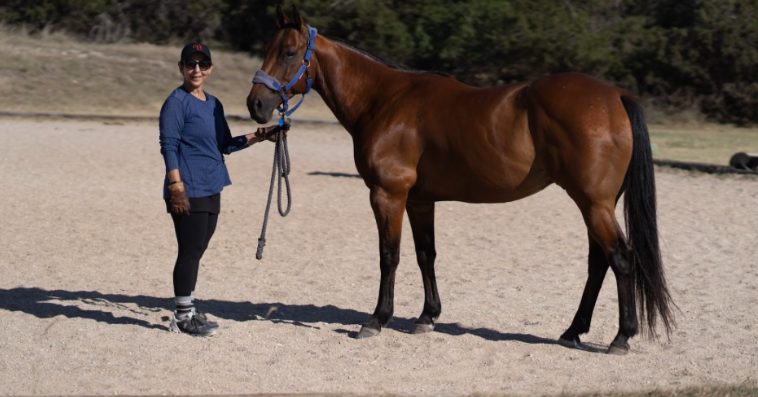
Reem and Blu.
What a horse notices
Prey animals survive by reading intention and arousal faster and more accurately than we do. A horse will move away from someone who is saying all the right things while holding their breath, and settle next to someone who has genuinely arrived. It is not mystical. It is a very good sensor pointed at exactly the thing therapy usually has to infer from words.
That makes horses an unusually direct teacher of presence, and an unusually honest mirror for the gap between what you intend and what you are actually doing. People who have spent years being competent at therapy often meet something here they have been able to talk their way around indoors.
The horse is Blu. He is not a prop and he is not trained to perform anything therapeutic; he simply responds to whoever is standing in front of him, which is the entire point.
What happens in a session
- Arriving, and noticing what your body does on the way in.
- Being near the horse, without a task, longer than feels comfortable.
- Simple ground work: approaching, leading, stopping, asking.
- Talking about what just happened, which is where the therapy lives.
Why online sessions come first
One to three online sessions before the first equine session is not a formality. It establishes pacing, gives you a way to settle that you have already practiced, and means neither of us is meeting the other for the first time in a field. The same requirement applies to trail walk sessions.
Who it suits
People who talk more easily when something else is happening. People whose self-awareness is strong in words and thin in the body. People working on boundaries, because asking a thousand-pound animal to move is boundaries with the abstraction removed.
Who it does not
Anyone under 18, anyone with a horse allergy, and anyone currently in crisis, for whom stabilization online comes first. If you are frightened of horses, that is worth discussing rather than ruling yourself out: fear is workable material, but it should be chosen rather than endured.
The arrangement, in numbers
- Where
- Near Dripping Springs, Texas, about forty minutes from Austin
- Who
- Adults 18 and over
- Riding
- None. All work is on the ground.
- The horse
- Blu
- Before starting
- A free consult plus one to three online sessions
- Client sessions
- $185 to $240 for a session of 1.5 to 2 hours
- Insurance
- Equine sessions are not billed to insurance and are paid directly. Why, and what to ask your plan.
- LPC Associates in supervision here
- $60 a session, optional
- Therapists
- Equine training and retreats, fees per offering
- Weather
- Sessions are rescheduled rather than pushed through
Related
Walk and talk therapy
The other in-person option: trails in central Texas on Fridays, one hour, $125.
For therapists
Equine-assisted training, the annual mindful trail retreat, and equine supervision sessions at $60.
Somatic Experiencing
The lens underneath the equine work: tracking what the nervous system is doing rather than what the story says.
All therapy options
Online sessions across Texas, the conditions worked with, and the practice's LPC Associates at lower fees.
Questions about equine therapy
Do I ride the horse?
No. All of the work is on the ground. This is equine-assisted psychotherapy, not therapeutic riding, and no riding experience is needed or wanted.
Where do the equine sessions happen?
Near Dripping Springs, Texas, roughly forty minutes from central Austin. The specific location is arranged with you once the online sessions are done.
Who is the horse?
Blu, a bay gelding, near Dripping Springs. You work with him on the ground. He has no routine to run through and nothing to demonstrate; what he does is respond to your state, which is what makes the session useful.
Do I need experience with horses?
None at all. Most people arrive with no horse experience, and the session is built around noticing rather than skill. Being nervous around horses is workable material, not a disqualification, but it should be something you choose to walk toward.
Can I start with an equine session?
No. Walk, movement and equine sessions all begin after a free consult and one to three online sessions, so we know each other before we are outside. The pacing and the working relationship are established before the setting changes.
Is equine therapy available for teenagers?
No. These sessions are for adults 18 and over. The practice does not work with young children and does not offer in-person sessions to anyone under 18.
Do you offer equine work for therapists rather than clients?
Yes, and it is a separate offering. LPC Associates supervised by Reem can add equine supervision sessions at $60 each, and training for therapists who want to work with horses themselves is available through retreats and training.
How can I learn more?
The frequently asked questions page collects everything that is not specific to one service: fees and insurance, how the methods differ, complex PTSD, what Texas requires of a counselor, and how to start. If the answer is not there either, a free consult is the quickest way to get one.
This practice does not provide emergency care. If you are in immediate danger, call 911. For a mental health crisis, call or text 988 for the Suicide and Crisis Lifeline.
Start with a conversation
Therapy consults are fifteen minutes. Supervision and EMDR consultation consults are thirty. Both are free and commit you to nothing.